
Temporary civil engineering works are often treated as a means to an end. But in marine, river, and coastal construction, cofferdams are frequently the most critical element of the entire project.
Cofferdams create a dry, stable working environment in locations dominated by water, soft ground, tidal influence, and variable loading. They are relied upon to control groundwater, resist external pressures, and protect both the workforce and surrounding environment throughout construction.
At Stockton Group, we see time and again that the success of a cofferdam installation is determined long before steel reaches site. A comprehensive design and feasibility study is not an optional extra, it’s a fundamental step to help manage risk, cost, and programme certainty.
Here, our Director, Gearoid O’Connell explains why thorough upfront assessment is essential and how it underpins safe and effective cofferdam delivery.




A cofferdam is a temporary retaining and exclusion structure built to allow construction to take place below water level. Typically formed from sheet piles, tubular piles, or combined wall systems, cofferdams resist external water pressure while enabling excavation, foundation works, or structural installation within a controlled dry environment.
Unlike many temporary works, cofferdams are exposed to continuous hydrostatic pressure, variable ground conditions, tidal loading, and often complex construction sequencing. Failure or excessive movement can have immediate safety, environmental, and programme consequences.
Ground conditions beneath rivers, estuaries, and coastal zones are rarely uniform. Alluvial deposits, soft clays, gravels, obstructions, and historic fill can vary significantly over short distances. Without a robust ground model, cofferdam design assumptions quickly become unreliable.
A feasibility study brings together geotechnical data, hydrogeological assessment, structural demand, constructability, and environmental constraints. It allows designers to assess whether a proposed cofferdam type is appropriate, how it will behave during excavation, and what temporary or permanent measures are required to maintain stability.
This early-stage analysis reduces the likelihood of unexpected seepage, base heave, excessive deflection, or emergency remedial works once construction is underway.
Water pressure is often the governing factor in cofferdam performance. External hydrostatic forces increase with depth and tidal range, while internal groundwater levels change as excavation progresses.
A comprehensive design study evaluates:
Uplift and base stability risks
Seepage paths and cut-off requirements
Wall stiffness and embedment depth
The need for internal bracing, props, or anchors.
Without this analysis, cofferdams may be under-designed, leading to excessive deformation, or over-designed, resulting in unnecessary cost and installation complexity. Cofferdam performance cannot be separated from how it is built.
Feasibility studies consider access constraints, plant availability, noise and vibration limits, and the interaction between piling, excavation, and structural works. They also assess how the cofferdam will be installed and removed safely without destabilising adjacent assets or the permanent works.
By integrating construction methodology into the design phase, risks associated with tight sites, live waterways, or restricted working windows can be addressed before they affect the programme.
Cofferdams are often constructed in environmentally sensitive locations where disturbance must be carefully controlled. Turbidity, sediment migration, and impacts on aquatic habitats are key concerns for regulators.
Early feasibility allows mitigation measures, such as sealed joints, internal water treatment, or reduced footprint solutions, to be incorporated into the design. This supports smoother consenting processes and reduces the likelihood of costly delays caused by non-compliance.
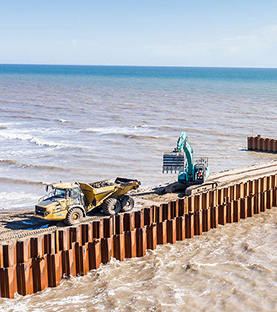
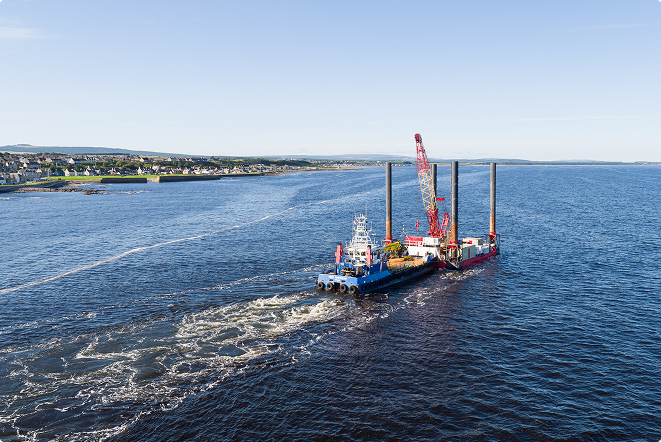
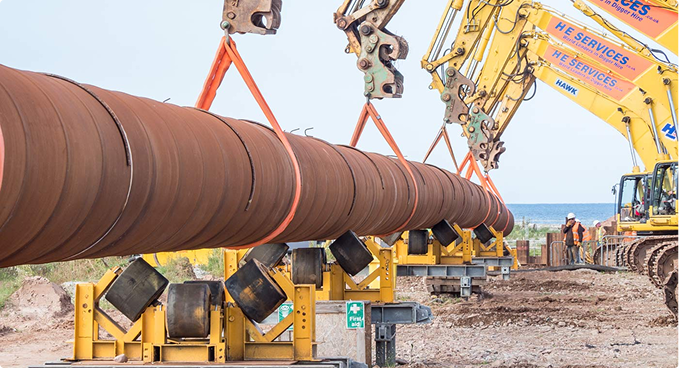
Here at Stockton, we constructed a 197m long cofferdam into the intertidal zones of the North Sea, as part of a gas pipeline installation at the Tolmount gas field. This was facilitated using a winch with a 550-tonne pull capacity.
The cofferdam provided a safe working area and a critical entry point for the pipe to be pulled through, helping secure the UK’s natural gas supply and the continued operation of Easington Gas Terminal.
Cofferdams may be temporary, but the risks they carry can be permanent. In complex water-based construction, they often dictate whether a project proceeds safely, on programme, and within budget.
A comprehensive design and feasibility study provides clarity in uncertain conditions. It transforms unknowns into managed risks and ensures that cofferdams perform as intended from installation through to removal.
With extensive experience delivering complex marine and temporary works solutions, Stockton Group supports clients from early feasibility through to construction. To discuss cofferdam design or feasibility support on your project, contact our team today.
Cofferdams can’t be designed with standard details because ground conditions, water depths, tidal ranges, and construction methods vary significantly from site to site. Standard details rarely address the specific risks present in marine or fluvial environments so a bespoke approach must be taken for each project.
The main risks of insufficient upfront design are increased likelihood of seepage, instability, excessive wall movement, programme delays, safety incidents, and unplanned remedial works.
While there is an upfront investment for a feasibility study, comprehensive studies typically reduce overall project costs by avoiding overdesign, delays, and construction-stage redesign.
Cofferdam design would ideally be considered at concept or early planning stage, alongside permanent works design, to ensure interfaces, loads, and sequencing are fully understood.
While most cofferdams are temporary, their performance directly affects permanent works’ quality and safety making their design just as critical.

